
Airflow Designed for Balanced System Performance
Ductwork Installation in Crossett for new construction and replacement projects where proper distribution prevents comfort complaints
Rooms that stay warmer than others, supply registers that barely move air, and HVAC systems that run continuously without reaching setpoint often trace back to undersized, leaking, or poorly routed ductwork rather than equipment failure. CSC of Crossett installs ductwork for new construction and duct replacement projects across residential and commercial properties in Crossett, designing airflow distribution that matches equipment capacity to room-by-room load requirements. Proper duct sizing uses calculations based on cubic feet per minute airflow rather than guessing diameter, preventing velocity problems that create noise and pressure imbalances.
Installation involves routing supply and return ducts with minimal turns, sealing joints with mastic rather than tape that fails over time, and insulating runs through unconditioned spaces where temperature differences cause efficiency losses. Commercial applications require balancing dampers at branch takeoffs to adjust airflow room by room after installation completes. Quality materials and proper installation prevent the air leaks that waste conditioned air into attics and crawlspaces before reaching occupied spaces.
Request an airflow design estimate to address comfort problems caused by existing ductwork inadequacies.
What Proper Airflow Design Accomplishes
Ductwork design accounts for the distance between the air handler and each supply register, calculating trunk and branch sizes that deliver the specified CFM without excessive velocity that generates whistling noise. Return air sizing receives equal attention since undersized returns create negative pressure that pulls unconditioned air through building envelope leaks. Technicians verify that total supply CFM matches equipment specifications, preventing the reduced airflow that causes evaporator coils to freeze or heat exchangers to overheat.
Once installation finishes, rooms reach target temperatures at similar rates without the hot and cold spots that indicate airflow imbalance, and supply registers deliver consistent air volume across the system. Testing confirms static pressure readings within manufacturer ranges for installed equipment, and sealed ductwork eliminates the dust infiltration and energy losses associated with leaky joints in unconditioned spaces.
Ductwork installation coordinates with HVAC equipment placement to minimize run lengths and avoid structural obstacles that require excessive fittings. Projects may involve attic reinforcement for duct support or cutting access openings that require patching afterward, depending on building layout and existing conditions.
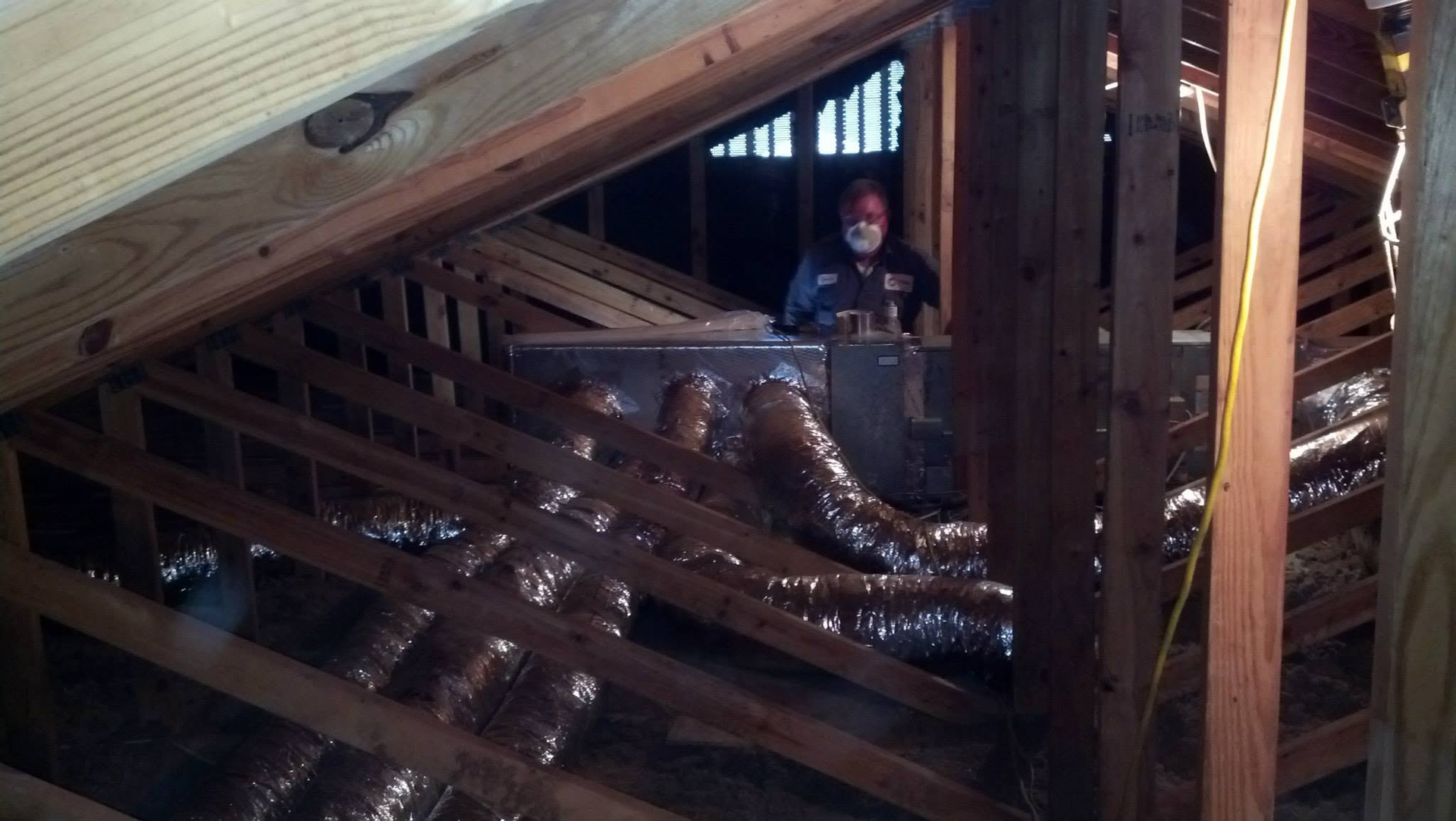
Ductwork questions from Crossett property owners focus on design requirements and the impact of proper installation on system performance.
What determines correct duct sizing?
Manual D calculations measure equipment CFM output, room-by-room cooling loads, and duct run lengths to specify trunk and branch diameters that deliver design airflow without excessive velocity or pressure drop through fittings and turns.
How does duct sealing affect energy efficiency?
Leaks in attic or crawlspace ductwork waste twenty to thirty percent of conditioned air before it reaches living spaces, forcing equipment to run longer and increasing utility costs compared to sealed systems tested with duct blaster equipment.
When should existing ductwork be replaced?
Ducts with extensive deterioration, asbestos insulation, disconnected sections, or sizing incompatible with new equipment justify replacement rather than attempting repairs that don't address fundamental design problems.
What materials are used for residential ductwork in Crossett?
Sheet metal trunks and insulated flex duct branches are common for residential installations, with joints sealed using fiber-reinforced mastic and insulation wrapping applied to metal ducts in unconditioned spaces to prevent condensation and heat transfer.
Why does balanced airflow matter?
Properly designed and installed ductwork delivers proportional airflow to each room based on its cooling load, preventing comfort complaints from undersupplied spaces while avoiding the noise and inefficiency of oversized ducts moving air at high velocity.
What Property Owners Usually Ask
CSC of Crossett provides ductwork installation for properties throughout Crossett requiring improved airflow distribution and system efficiency. Contact (870) 304-2121 to schedule a consultation that includes airflow analysis and ductwork design based on your property's specific layout and HVAC capacity.